
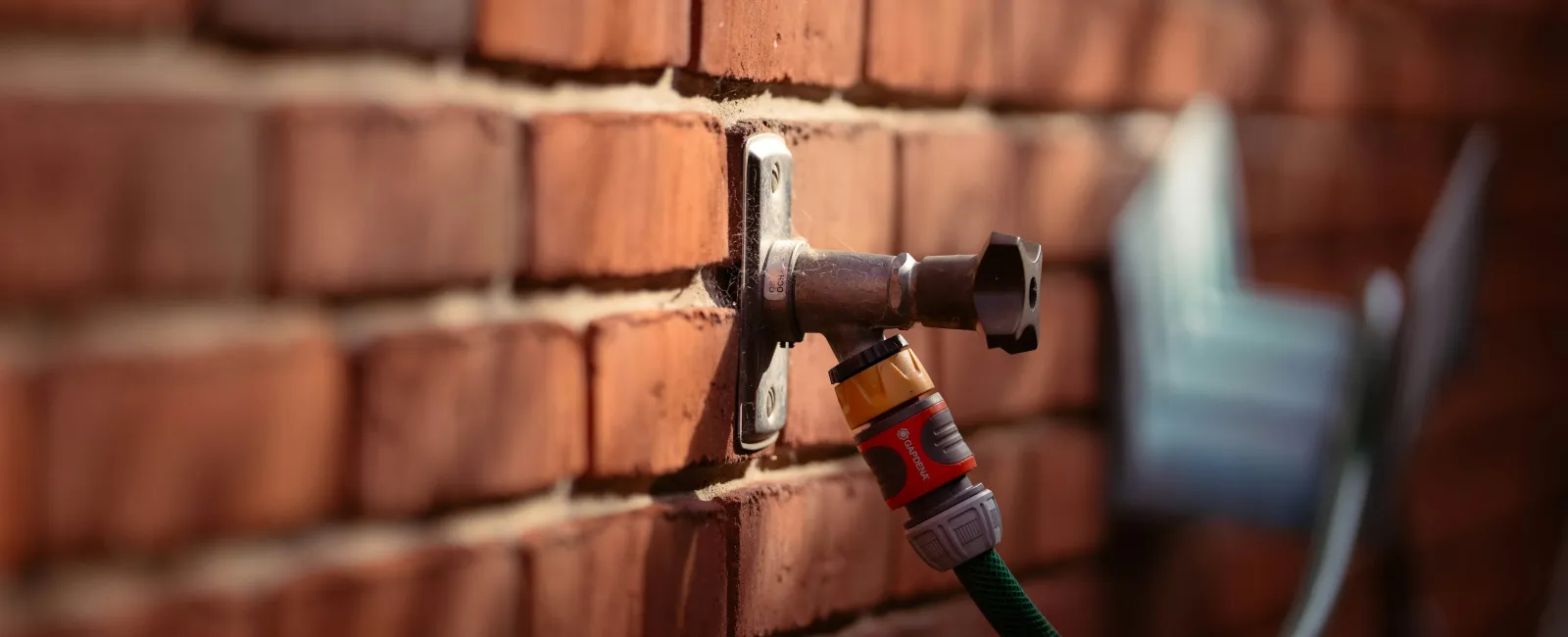
A hose bib leaking is a slow but persistent water release from the outdoor faucet attached to your home, almost always caused by a worn rubber washer, a loose packing nut, a failing vacuum breaker, or a cracked faucet body from freeze damage. The visible drip usually looks harmless, but a leaking hose bib can waste thousands of gallons of water per year, drive up your monthly water bill, and quietly damage the framing, sheathing, and foundation hidden behind the wall it's mounted on. Most outdoor faucet leaks are inexpensive to fix when they're caught early. The cost climbs sharply once water has been seeping into the structure for weeks or months.
A leaking hose bib is one of the easiest plumbing problems in the house to ignore. Total Mechanical Care has been repairing and replacing outdoor faucets across North Metro Atlanta since 1923, and the pattern is consistent: the homeowners who catch a leaking hose bib in the first week pay for a small part. Those who wait until next spring pay for framing repairs and a new section of the supply line.
The Hidden Damage Behind a "Small" Outdoor Faucet Leak
A drip that adds up to roughly one drop per second wastes about 5 gallons of water per day. A faster leak, or one running constantly because the valve isn't sealing at all, can put hundreds of gallons through your meter in a week. None of that shows up as a flood. It shows up on your water bill as a steady, unexplained increase that gets blamed on the kids' baths or longer showers until someone finally notices the puddle next to the foundation.
The bigger concern is what the leak is doing to the house's structure. A hose bib is mounted through your exterior wall, which means a leak at the base of the faucet, around the threads, or inside the wall is depositing water directly onto your sheathing, insulation, and framing. Wet wood rots. Wet insulation loses its R-value and stops drying out. In humid Georgia summers, those conditions become an active mold environment. Foundations adjacent to a chronic leak can settle unevenly as the soil around them becomes saturated, which is one of the more expensive structural problems a homeowner will ever pay to fix.
There's also the freeze risk. If a hose bib already leaks in late fall, the standing water inside the valve body is a near-guarantee of a split pipe the first time temperatures drop below freezing. A frozen and burst hose bib often doesn't reveal itself until you turn the faucet on the following spring, at which point water pours into the wall cavity instead of out the spigot. Emergency plumbing calls for burst hose bib lines spike every March and April for exactly this reason.
Why Your Hose Bib Is Leaking: The Most Common Causes
The location of the leak tells you almost everything about what's wrong. A hose bib leaking from the spout, handle, top, or base indicates a failed component inside the valve.
A Worn Washer or O-Ring (Leaking From the Spout)
The most common cause of a leaking outdoor faucet is a worn rubber washer at the bottom of the valve stem. Every time you turn the handle, that washer compresses against a metal seat to stop water flow. After enough cycles, the rubber hardens, deforms, or splits, and water starts seeping past it even when the handle is fully closed. The classic symptom is an outdoor faucet leaking when turned off, with a steady drip from the spout. This is usually an inexpensive repair involving a washer replacement and reseating, assuming the metal seat itself isn't pitted or corroded.
A Loose or Failing Packing Nut (Leaking From the Handle)
If your outdoor faucet is leaking from the handle when the water is turned on, the problem is almost always at the packing nut, the brass nut just below the handle that keeps water from escaping up around the stem. Over time, the packing material inside that nut compresses and stops sealing properly. Tightening the packing nut a quarter turn fixes some cases. Others require replacing the packing washer or O-ring inside the nut.
A Damaged Vacuum Breaker (Leaking From the Top)
Most modern hose bibs have a small dome-shaped device on top called a vacuum breaker or backflow preventer. It exists to keep contaminated water from a hose (sitting in a bucket, a pool, or a fertilizer mix) from being siphoned back into your home's drinking water supply. When the internal seal in a vacuum breaker fails, water sprays or dribbles out of the top of the faucet whenever it's turned on. Vacuum breakers are inexpensive parts that are often replaceable on their own, without replacing the entire faucet. They're also required by code for residential outdoor faucets in most jurisdictions, which means a missing or non-functional one is a compliance issue as well as a leak issue. For more details, see understanding backflow and how a backflow preventer works.
A Cracked Faucet Body From Freeze Damage
When water inside a hose bib freezes, it expands, and brass or copper splits. The crack often forms inside the wall where you can't see it. The leak then shows up months later, after the thaw, as water dripping from the base of the faucet, running down the siding, or appearing as a damp spot on the interior wall. This is the most expensive type of hose bib leak because it typically requires cutting into the wall to access the supply line and replacing the entire faucet, often with a frost-free model.
A Corroded Valve Seat or Stem
The metal seat that the rubber washer presses against can corrode, pit, or scale over time, especially in homes with hard water. Once the seat is rough, no replacement washer will seal against it cleanly, and the faucet will keep dripping no matter how many washers you swap in. At that point, the seat itself needs to be reground or replaced, or the faucet needs to be swapped out entirely. Persistent drips after a fresh washer almost always point to a damaged seat. Learn more about signs of hard water in your Georgia home (and what they mean).
Loose or Damaged Connections Behind the Wall
Sometimes the hose bib itself is fine, and the leak is coming from the soldered or threaded joint where the supply line connects to the faucet inside the wall. This shows up as water staining on the interior drywall near the faucet, a damp baseboard, or water visible at the base of the faucet on the outside. Repairs of this kind fall under plumbing repairs and water line work rather than a simple faucet swap, and trying to fix them from the outside without addressing the connection inside the wall rarely works.
When You Can Fix a Leaking Hose Bib Yourself, and When to Call a Plumber
A handy homeowner with a wrench can usually handle a worn washer, a loose packing nut, or a replacement vacuum breaker. Shut off the water at the dedicated valve inside the basement or crawl space, drain the line by opening the faucet, and replace the failed component with a matching part from a hardware store.
Call a licensed plumber when the leak is coming from the wall, from the base of the faucet, or from the interior side of the exterior wall; when the faucet body is cracked or visibly corroded; when freeze damage is suspected; when you have a frost-free model that needs internal stem replacement; or when the leak persists after you've replaced the obvious wear parts. These situations involve cutting into walls, soldering or PEX work, and sometimes addressing water damage that's already started. A misdiagnosed DIY repair on a buried supply line connection can turn a one-hour service call into a multi-day repair.
Preventing Hose Bib Leaks Before They Start
Disconnect garden hoses before the first freeze every fall. A hose left attached traps water inside the faucet body and is the single most common cause of freeze-cracked hose bibs in the Atlanta metro. If your home has standard (non-frost-free) outdoor faucets, an upgrade to frost-free models is one of the highest-value plumbing improvements available, and one our team installs regularly across Georgia. Insulated faucet covers help in mild freezes, but they aren't a substitute for actually disconnecting the hose. An annual inspection of every outdoor faucet on your property catches early-stage drips, loose packing nuts, and corroded vacuum breakers while they're still small repairs rather than structural ones. The same walk-through is also a good time to check for other gradual plumbing changes that point to bigger issues developing in the supply system.
Get Your Leaking Hose Bib Fixed Before It Becomes a Bigger Problem
A leaking outdoor faucet is rarely an emergency. The damage it causes when ignored is an emergency. If you've noticed a drip, a wet spot at the base of the faucet, an unexplained jump on your water bill, or any sign that your hose bib isn't shutting off cleanly, it's worth having a professional take a look before the next freeze, the next storm, or the next billing cycle.
Total Mechanical Care has been handling outdoor faucet repairs, replacements, and freeze-damage repairs for homeowners across Cumming, Alpharetta, Roswell, Marietta, and the surrounding North Metro Atlanta area for over 100 years. We can diagnose the source of the leak, tell you whether it's a washer or something more serious, and get it fixed the same day in most cases. Call us or book a service appointment online, and we'll take care of it.


