
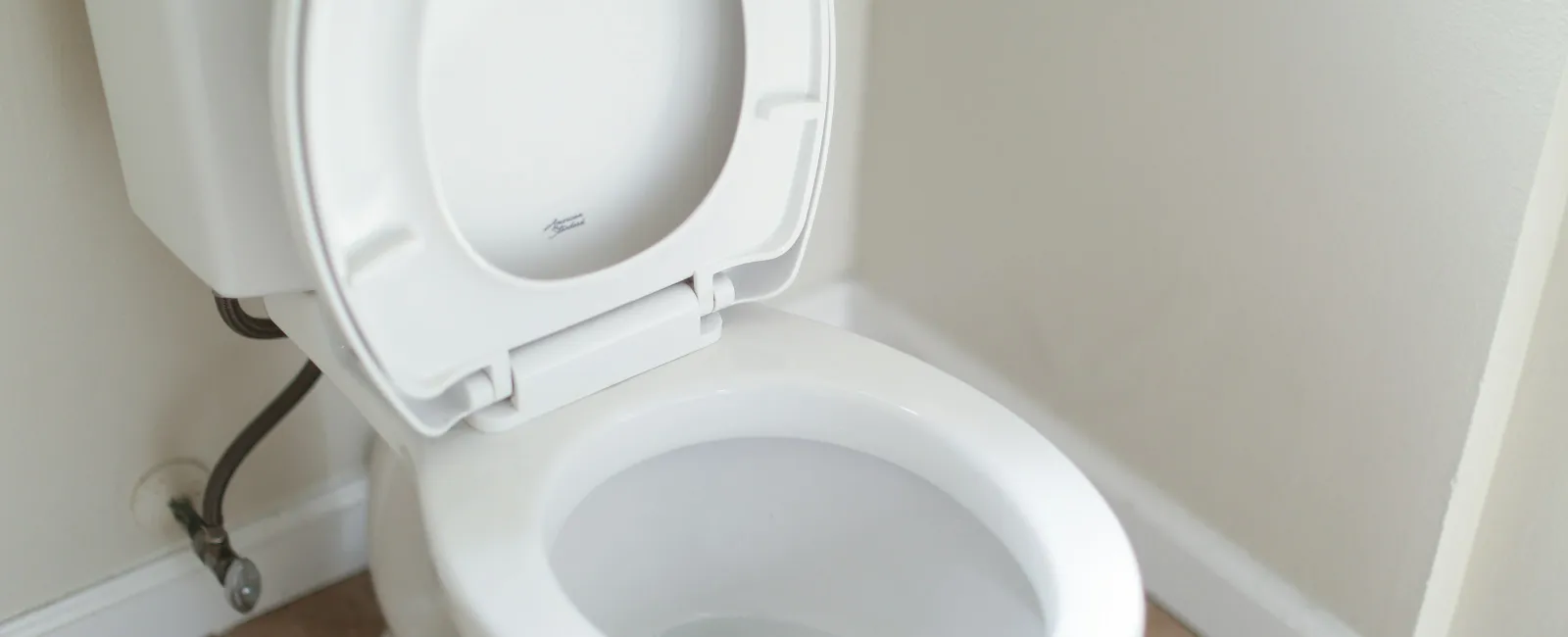
Water pooling where your toilet meets the floor looks the same no matter what is causing it. A failed wax seal leaves the same small puddle as a tank sweating on a humid August afternoon, and the two repairs have nothing in common.
The timing of the water is what separates them, and you can sort that out yourself in about an hour without tools.
Start By Finding Out When the Water Appears
Dry the floor completely, including behind the bowl where most people stop wiping. Lay dry paper towels in a ring around the base and along the supply line. Then leave the bathroom alone for an hour without flushing.
What you find when you come back points directly at the source.
| What you see | Most likely cause |
|---|---|
| Towels dry until you flush, then wet | Wax ring or closet flange seal |
| Slow, steady dampness with no flush | Tank condensation or supply connection |
| Water only at the wall side of the toilet | Supply line or shut-off valve |
| Water appears when the toilet rocks | Loose closet bolts breaking the seal |
| Water with a slow or backed-up bowl | Blockage in the drain line |
That single test separates a seal problem from a supply problem, and those two repairs have almost nothing in common.
The Wax Ring Is the Most Common Cause
Underneath your toilet sits a ring of wax compressed between the base of the bowl and the closet flange, which is the fitting that connects to your drain pipe. That wax has no moving parts and nothing to wear out mechanically, but it does deform permanently. Once it has been squashed out of shape by a toilet that shifts, it does not spring back.
Water escaping past a failed wax ring only appears during and just after a flush, because that is the only time water is moving through the connection under pressure. If your towels stayed dry for an hour and then soaked after one flush, this is your answer roughly nine times out of ten.
A Rocking Toilet Breaks the Seal It Sits On
Put a hand on each side of the bowl and try to rock it. Any movement at all means the two closet bolts holding the toilet to the floor have loosened, or the floor underneath is no longer flat.
Every rock grinds the wax seal a little further out of position. This is why a toilet that has wobbled for months eventually starts leaking even though nothing else changed.
Pry off the plastic caps at the base and tighten each bolt a quarter turn at a time, alternating sides. Stop the moment the rocking stops. Porcelain cracks under uneven pressure, and overtightening one bolt is one of the more expensive mistakes a homeowner can make on a Saturday. If the toilet still rocks after the bolts are snug, the floor is uneven and needs shims, not more torque.
Condensation Can Look Exactly Like a Leak
In Georgia summers, cold water sitting in a porcelain tank pulls moisture out of humid bathroom air and drips it down the outside of the tank onto the floor. The puddle collects at the base, which is precisely where you would expect a wax ring failure to show up.
Wipe the outside of the tank. If it is wet all over rather than dry with a wet floor below, you are looking at condensation. Running the bathroom fan during showers, keeping the door open afterward, and fixing a flapper that keeps letting cold water refill the tank will handle most cases.
This one does not need a plumber, and any plumber who quotes you a toilet reset without checking the outside of the tank first has skipped the free answer.
The Supply Line and Shut-Off Valve Are Easy to Rule Out
Follow the flexible line from the wall to the bottom left of the tank. Dry both threaded connections and the valve body, then wrap a strip of toilet paper around each one. Tissue shows a slow weep within minutes that your fingers will never feel.
Braided steel supply lines fail from the inside as the rubber core ages, and the older chrome shut-off valves in North Georgia homes commonly seep at the packing nut once they have been turned for the first time in a decade. We handle supply line repairs and shut-off valve replacements as part of general plumbing service, and both are quick jobs when caught before the water reaches the subfloor.
When the Flange Is the Problem
The closet flange is a ring of plastic, brass, or cast iron anchored to the floor, and it does two jobs at once. It seals the toilet to the drain and it holds the bolts that keep the toilet from moving.
Flanges crack, corrode, and sometimes sit too low after new flooring is installed on top of the old. When that happens, a new wax ring alone will not fix the leak, because the seal has nothing solid to compress against. The toilet has to come up so the flange can be repaired with a reinforcement ring or replaced outright.
This is the point where the repair stops being a homeowner job. Pulling a toilet means disconnecting the supply, breaking the seal, lifting sixty to a hundred pounds of porcelain without chipping it, and setting it back down square on the first attempt.
What the Floor Tells You About How Long It Has Been Leaking
A base leak that has been running for a while leaves evidence before it leaves a puddle. Discolored or crumbling grout at the base, vinyl or laminate lifting at the seams, and a floor that feels soft or spongy when you step next to the bowl all point to water that has been getting into the subfloor.
If there is a finished room below, check the ceiling underneath the bathroom for staining. A toilet on a second floor can leak into a ceiling for weeks before anything shows up on the bathroom floor itself.
Once the subfloor is saturated, the repair is no longer about the toilet. That is the reason we tell people not to wait on a leak they have already noticed twice.
Should the Toilet Be Reset or Replaced?
Most base leaks are fixed by resetting the existing toilet with a new wax ring and new closet bolts. The fixture itself is almost never the problem, and there is no reason to buy a new toilet because the seal under the old one gave out.
Replacement makes sense when the porcelain is cracked, when the toilet is old enough that parts are getting hard to source, or when it has needed repeated repairs already. We repair and replace toilets either way, and our plumbers will tell you plainly which one your situation calls for. You get the flat-rate price before any work starts.
What to Try Before You Call
- Dry the floor and the tank, then run the paper towel test for an hour without flushing.
- Check whether the toilet rocks, and snug the closet bolts a quarter turn at a time if it does.
- Wrap tissue around the supply connections and the shut-off valve to catch a slow weep.
- Wipe the outside of the tank to rule out condensation.
- Shut off the valve behind the toilet and stop flushing that fixture if water keeps appearing.
Schedule Toilet Repair in Cumming, Alpharetta, or Roswell
Total Mechanical Care has been working on North Georgia plumbing since 1923. Our licensed plumbers pull the toilet, inspect the flange and the subfloor while it is up, and reset it properly rather than stacking a second wax ring on a problem that will come back.
If you have water at the base of your toilet, a bowl that rocks, or a floor that has started to feel soft, we can look at it and tell you honestly whether it is a seal, a flange, or something under the floor.
Call 404-907-1924 or book service online.


